
We test technologies
Technology Center Mongstad (TCM) offers the world´s most advanced and flexible test arena for CO2 capture technologies.
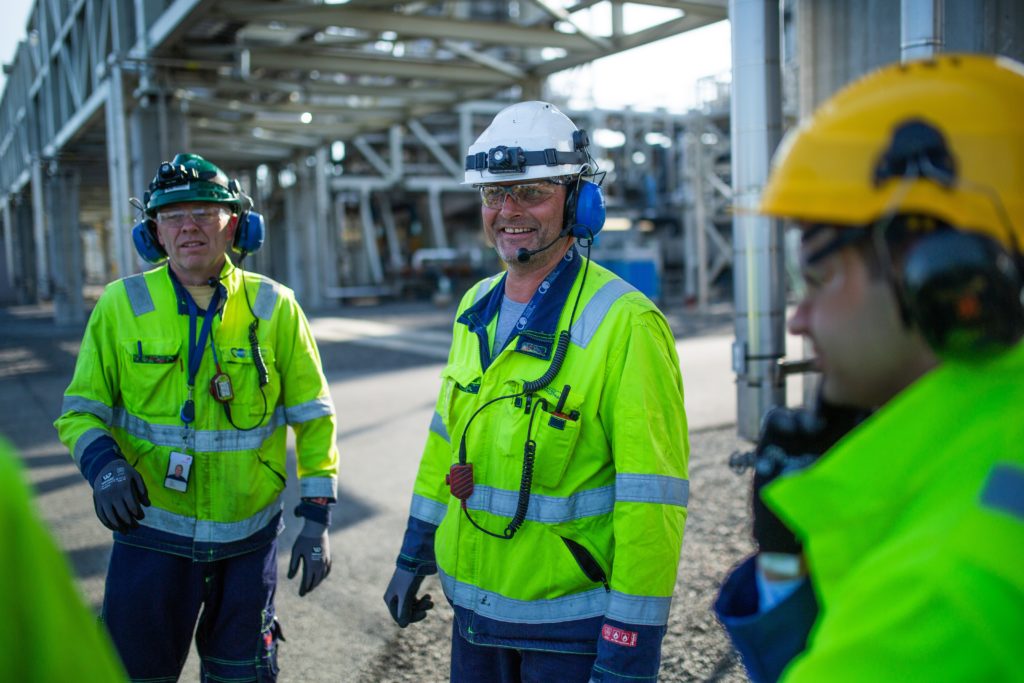
Testing at TCM
Private companies from all over the world come to TCM to test and develop efficient and technical safe technologies which can be used at onshore industrial plants. In addition, scientific technology testing is conducted at TCM, serving as a benchmark for commercial technologies.
Our experience in testing both commercial and open (non-proprietary) technologies makes us a leading centre of expertise in carbon capture. We have achieved excellent test results for our partners, based on trust and confidentiality for each individual client.
TCM’s CO2 capture test facilities consist of an amine plant, an ammonia plant and a site for emerging technologies. We use two industrial flue gas sources; from Equinor’s Residue Cracker/RFCC at their refinery in Mongstad (approx. 13-15 per cent CO2) and from the associated Mongstad Heat Plant (MHP) (8-9 per cent CO2). The different flue gas sources make it possible to simulate emissions from different industries, such as cement production, steel, waste management and oil refining. TCM operates in accordance with emission permits issued by the Norwegian authorities and meets all requirements for safety and measurement of results in the operation of the test facility.
In all of our technology testing, we are able to capture a significant proportion of the CO2. Therefore, the main focus is reduction of capture costs and environmental and technical risks, so that mass deployment of CO2 capture becomes affordable and plausible.
Private companies testing at TCM
Since the operation of the test facility started in 2012, the following private companies have conducted test campaigns at TCM:
- Aker Clean Carbon (now SLB Capturi), (Norway), on the amine plant, 2013-2014
- Alstom SA (USA), at the amonia plant, 2013 – 2014
- Cansolv Technologies Inc / Shell Catalysts Technologies, (Netherlands) on the amine plant, 2014 – 2015, 2016 and 2023
- Carbon Clean Solutions (UK/India), on the amine plant, 2015 – 2016
- Fluor Corporation (USA) on the amine plant, 2019
- Honeywell (USA) on the amin plant, 2024
- ION Clean Energy (USA), on the amine plant, 2016 – 2017 and 2023 – 2024
- InnoSepra (USA), at the Site for Emerging Technologies, 2023 – 2024
- Mitsubishi Heavy Industries Engineering (Japan), on the amine plant, 2021
- MOF4AIR (European Union) at the Site for Emerging Technologies, 2024
- Membrane Technology and Research (USA), at the Site for Emerging Technologies, 2021
- Prospin as part of the ACCSESS Project (European Union) at the Site for Emerging Technologies, 2023
- RTI International (USA), at the amine facility, 2022
- TDA Research (USA), at the Site for Emerging Technologies, 2021
- Saipem as part of the ACCSESS Project (European Union) at the Site for Emerging Technologies, 2023
- Svante (Canada) at the Site for Emerging Technologies, 2024-2025
It is fundamental to TCM that private companies have confidence in our handling of their technologies. We have specific systems and routines in place to ensure their confidentiality.
Private companies that choose to use our facilities typically receive financial support from the authorities in their home countries. For example, the US Department of Energy (DoE) has provided financial support to six US companies that have come to TCM to test advanced carbon capture technology. ION Clean Energy, Fluor Corporation, a global engineering and construction company, RTI International and InnoSepra have all tested with us. The National Energy Technology Laboratory (NETL) manages all these agreements on behalf of the U.S. Department of Energy.
Scientific testing and research at TCM
The combined experiences from testing of recognized research-based and leading commercial technologies, has made TCM a global leading competence center in CO2 capture. Our policy is to share knowledge and experience from research activities to benefit the entire carbon capture and storage community through publications in reputed scientific journals and presentation at conferences on scientific technology test results.
Our research-based technology testing has been conducted with the openly available carbon capture liquid (solvent) called Mono Ethanol Amine (MEA). TCM has been able to capture up to 98 % of CO2 emissions with aqueous MEA (a blend of water and MEA), and to simulate a reduction of capture costs by nearly 18 % over several test periods (campaigns) under specific conditions. In 2019, TCM is testing a new open access capture liquid called CESAR 1 as part of the extensive EU-funded carbon capture and storage project ALIGN CCUS. In addition, the EU-funded MOF4AIR and ACCSESS projects, which involve new and ground-breaking technologies, have been tested at the Site for Emerging Technologies.
The scientific testing of capture technologies at TCM has resulted in over 70 scientific publications. Research related to testing at TCM has been presented in a number of scientifically recognized arenas, such as The Greenhouse Gas Control Technologies (GHGT), NETL Annual capture meeting, Trondheim Conference on CO2 Capture, Transport and Storage (TCCS), Post Combustion Carbon Capture (PCCC) and CCUS (Carbon capture, utilization and storage). TCM’s scientific contribution includes a much-needed focus on adressing the practical operation of an almost full-scale carbon capture plant.
Work in partnership with international academic environments
TCM collaborates with several universities and research institutions, among others SINTEF, the Norwegian University of Science and Technology (NTNU), , Imperial College London (ICL), University of Oslo (UiO), the Massachusetts Institute of Technology (MIT), the Technical University of Denmark (DTU), the University of Texas at Austin, the French National Center for Scientific Research (CNRS), the Korea Research Institute of Chemical Technology (KRICT),the National Energy Technology Laboratory (NETL), and University of Bergen (UiB).
The technology department at TCM is open to inquiries that can contribute to increased knowledge on carbon capture.
Multiple test units for different technologies
TCM currently has two test units. The amine plant is a unit with generic capabilities developed by Aker Clean Carbon, now part of Aker Solutions. The unit has been utilized by seven private companies in addition to scientific testing on the capture liquids MEA and CESAR 1. TCM also has a chilled ammonia unit, developed and licensed by former Alstom, now General Electric where Baker Hughes is commercialising the technology. Both these units capture CO2 by the means of a chemical liquid mix called solvent, consisting of water and either amine- or ammonia-based solutions.
In addition, TCM in 2021 established a new test site for emerging technologies. «Site for Emerging Technoligies» is used to test novel technologies such as membranes or absorbents (solid materials binding with CO2) and other state-of-the-art carbon capture technologies. These emerging technologies are at a lower technology maturity level and creates new opportunities for technology development. The American company TDA Research was the first user of TCM’s modular unit for testing new capture technologies, followed by Membrane Technology and Research (MTR) and InnoSepra. In addition, proprietary technologies from the EU projects ACCSESS and MOF4AIR have been tested in this area.
Participates in EU projects
TCM is currently a partner in three different EU projects.
ACCSESS
ACCSESS is a four-year Horizon 2020 project that aims to demonstrate technologies and produce tools and plans that enable widespread CCS deployment in Europe.
AURORA
AURORA is part of the EU’s Horizon 2020 project. It started in December 2021 and will receive a total of €4.6 million in funding until 2025. As an Innovation Action, the project has a strong applied focus and puts its innovative solutions into practice.
MOF4AIR
The overall objective of MOF4AIR is to demonstrate the performances of MOF-based CO2 capture technologies in power plants and energy intensive industries. To that purpose, MOF4AIR will demonstrate optimized MOF-based adsorbents with fine-tuned CO2 adsorption processes through a multidisciplinary approach.
How to get access to test at TCM
The prerequisite for a collaboration in a commercial context, is that the technology must be sufficiently mature (technology readiness level approx. 7 – 8 based on DOE/NETL scale). TCM holds an emission permit from the Norwegian Environmental authorities. Another prerequisite is to verify that the technology can perform within the limits set in the emission permit. After testing at TCM, the technology should in principle be ready for use in full-scale industrial plants.
Our business development department assists technology companies with information and advice about testing at our facility. We also take part in dialogue with governmental funding entities (ex. NETL, BEIS) and developers of carbon capture projects.
Lessons learned
The test campaigns at the plant have generated valuable lessons learned for both TCMs owners, the technology vendors, the institutions and organizations involved and the whole CCS community.
The companies involved report valuable lessons learned about how their respective capture solutions work in a large-scale facility, and how to minimize emissions, energy demand and costs. Typically, the technology providers share as little information as possible about their test campaigns. The vendors newfound knowledge is regarded as trade secrets.
However, the non proprietary campaigns has revealed a whole new insight into important improvements in generic capture technologies. This has benefited of the whole CCS community.
Test campaigns carried out at TCM have been conducted in broad collaboration with key CCS players.
Experiments are designed and executed with industrial partners representing various industries; electricity generation, municipal waste incinerators, oil and gas industry, steel manufacturing, etc., to support their CCS projects and their goals in reducing their CO2.
Experiments are designed and executed in collaboration with research institutes, e.g. SINTEF, and universities in order to overcome potential technical and operational challenges when operating large commercial CO2 capture plants
This means that the results are of great importance in the CCS professional world and for future industries that will use CCS. At TCM, they get a clearer picture of what it takes to run an efficient CCS plant. As more countries see the importance of carbon capture and storage, the experience they gain from almost full-scale testing at TCM is becoming increasingly important. For us, it is important to share knowledge from the open tests with researchers and academic communities around the world.
TCM’s unique test facilities, high competence and strong commitment to efficient capture, make an important contribution to solving the global climate challenges.